Understanding Prelim Results
How the ranking is calculated in each scoring system, and what the columns in the results table mean.
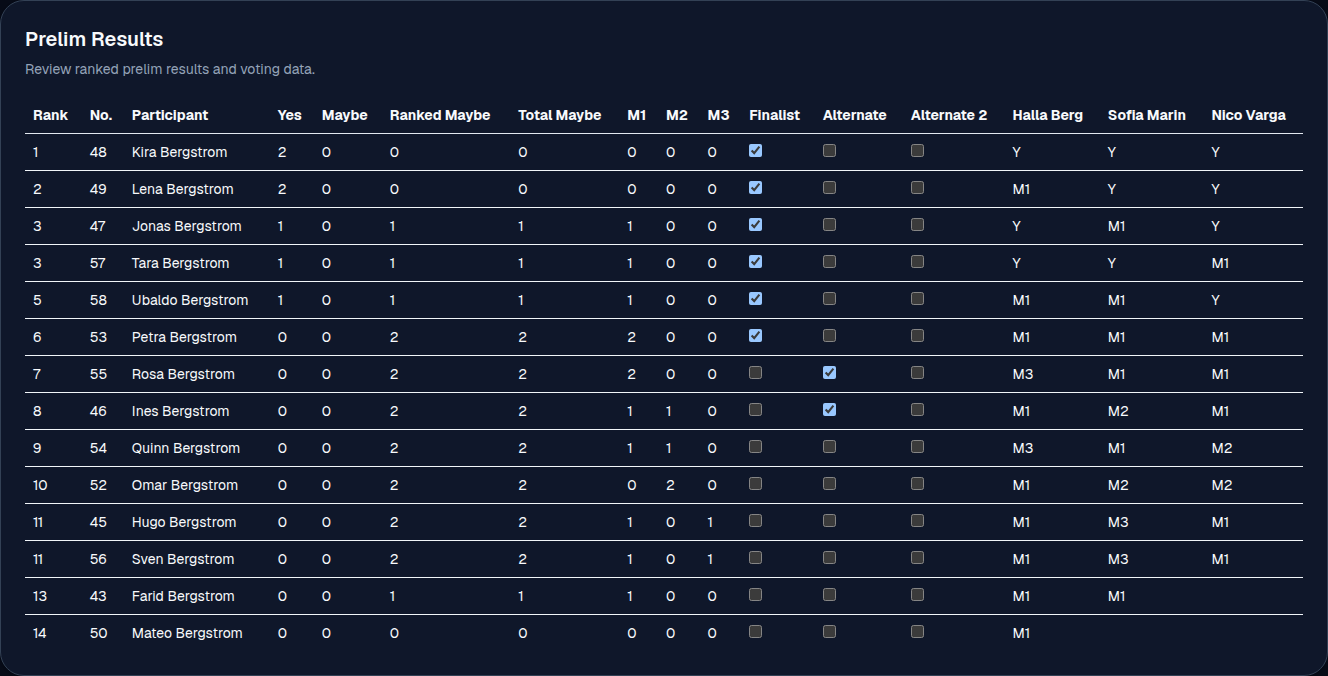
Once every judge has submitted and Calculate has been run, the Prelim Results card shows a ranked table. This page explains what you are looking at.
The results table
Each row is a participant (or couple). The columns:
| Column | Meaning |
|---|---|
| Rank | Position in the ranking (1 is top). Ties share a rank. |
| No. | The competitor number, the one the judges saw. |
| Participant | The name, or Leader: … / Follower: … for a couple. |
| Yes | Yes votes across all judges. |
| Maybe | (Unranked) maybe votes. |
| Ranked Maybe | Ranked maybe votes (M1, M2, M3). |
| Total Maybe | Maybe + Ranked Maybe. |
| Score (Weighted points only) | The participant's total weighted points. |
| M1 / M2 / M3 (Ranked maybes) | How many times the participant was ranked 1st, 2nd, or 3rd maybe. |
| Finalist / Alternate / Alternate 2 | Checkboxes you can toggle, or that the app fills in automatically (see below). |
| One column per judge | That judge's vote for this participant (Y, M, M1/M2/M3, or blank). |
How each system ranks
Regular (relative placement)
Each judge marks a yes for the top group, a maybe for the next group, or leaves a participant blank. The ranking starts from the raw vote counts (most yeses first, then maybes), and where it ties there it falls through a chain of relative placement metrics: the judge-majority placement, the number of judges agreeing, the point sum at that rank, and finally the head judge's placement and the participant number. Most common, and the easiest to explain to a dancer after the result.
Ranked maybes
Each judge marks a yes, then ranks their maybes M1, M2, M3 (best first). Ranking works the same way as Regular: yes = rank 1, M1 = rank 2, M2 = rank 3, M3 = rank 4, and so on. The table sorts by yeses, then ranked maybes, then M1/M2/M3 counts, then falls through the same relative placement chain as Regular — the rank at which a majority of judges agree, the size of that majority, the point sum making up the majority, the next distinguishing placement, head-to-head judge agreement, and finally the head judge's own placement and the competitor number.
Weighted points
Each judge marks a yes (1.0 points) and may rank maybes, where M1 = 0.6, M2 = 0.45, M3 = 0.3. The ranking is by score (highest first), then the head judge's placement, then yeses, then the M1/M2/M3 counts, then total maybes, then the competitor number.
Manual priority sorting
The ranking is whatever the organizer has placed by hand. The table is not computed from votes, and is used for curated finals and special exhibitions.
Tie-breaks at a glance
| System | Tie-break order |
|---|---|
| Regular | yeses, then maybes, then the relative placement metrics, then participant number |
| Ranked maybes | yeses, ranked maybes, M1/M2/M3 counts, then the same relative placement metrics as Regular, then participant number |
| Weighted points | score, head judge placement, yeses, M1, M2, M3, total maybes, participant number |
When a head judge is set, their placement enters the order above (as the relative placement tie-break for Regular and Ranked maybes, or as an earlier tie-break for Weighted points). That's applied automatically; nothing to configure. See Set a head judge.
Finalists, alternates, alternate 2
These are the rows that advance to the final. Once all judges have submitted and the target counts are set, the app auto-selects:
- the top Finalists to Select rows as finalists,
- the next Alternate 1 to Select rows as alternates,
- the next Alternate 2 to Select rows as alternate-2s.
Any row can be checked or unchecked by hand, and the app stops auto-selecting once you have edited. To return to the app's automatic pick, use Reset Selections; it confirms first, because it discards manual edits.
What the public page shows
Until you Publish, the public competition page says Prelim results have not been published yet. After publishing, the ranking appears, along with the scoresheet if one is published. See View results.